
Spark Plug Replacement and Maintenance Guide
How often to replace spark plugs, the signs of a worn set, and how plug type changes the interval. A practical spark plug maintenance guide.
What spark plugs actually do
Spark plug maintenance is one of those jobs that's easy to forget because a worn plug doesn't fail all at once. Each plug fires a spark across a small gap to ignite the fuel-air mixture in a cylinder, thousands of times a minute at highway speed. That gap erodes a little every time it fires, and the plug's tip slowly fouls with carbon and oil residue, until the spark gets weak enough that combustion starts to misfire instead of burning clean.
A weak plug shows up first as a small mileage penalty, then as a rough idle, and eventually as a check engine light for a misfire code. None of that is dramatic, which is exactly why plugs get ignored well past their replacement interval on cars that otherwise get good care.

How often to replace spark plugs
The interval depends entirely on the plug material, not the car. Basic copper plugs wear fastest and are usually rated for 20,000 to 30,000 miles. Platinum plugs roughly double that, landing around 60,000 to 80,000 miles. Iridium plugs, standard on most newer cars, commonly run 80,000 to 120,000 miles thanks to a much finer, more durable electrode tip.
Your owner's manual lists the exact number for your engine, and it's worth checking rather than assuming, since some performance and turbocharged engines call for shorter intervals regardless of plug material. Wheelscribe's mileage-based reminders can flag the job automatically once you log the interval, so it doesn't depend on remembering a number from a manual you read once.
Signs your spark plugs need replacing
A rough or uneven idle is usually the first thing you'll notice, often paired with a slight hesitation when you accelerate from a stop. Harder starts, especially in cold weather, are another early sign, since a weak spark has less margin when the engine is cold and fuel doesn't vaporize as easily.
A noticeable drop in fuel economy is common too, because a misfiring cylinder burns fuel it never fully ignites. If it gets bad enough, the check engine light comes on with a misfire code (typically P0300 through P0308), which is the point most owners actually act on it. Our car maintenance schedule guide covers where plugs fit alongside the rest of your routine service.
Copper, platinum, and iridium: picking the right plug
Stick with whatever plug type your manufacturer specifies unless you have a specific reason to change, since the ignition system is tuned around that plug's heat range and gap. Swapping to a plug with the wrong heat range can cause pre-ignition or fouling even if the physical fit is correct.
Gap matters as much as material. Most new plugs ship pre-gapped correctly for common applications, but it's worth confirming against spec with a gap gauge before installing, especially on older engines that call for a non-standard gap. A plug that's gapped wrong can misfire from day one no matter how new it is.
Replacing plugs yourself: what to watch for
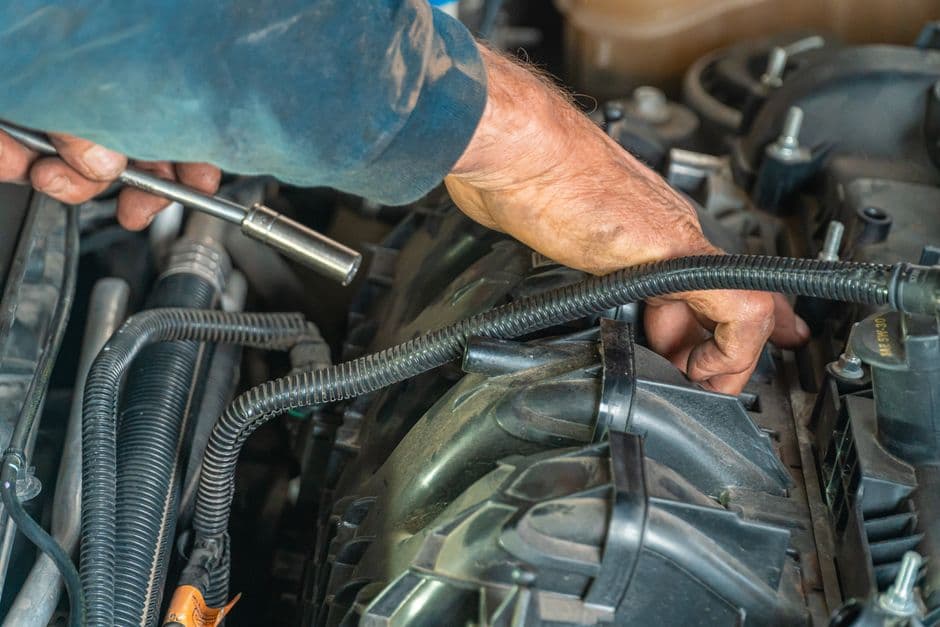
Spark plug replacement is a reasonable DIY job on most engines: pull the ignition coil or wire, remove the old plug with a spark plug socket, thread the new one in by hand to avoid cross-threading, then finish with a torque wrench to the spec in your manual. Overtightening is the most common mistake and can crack the porcelain insulator or strip the cylinder head threads.
Some engines bury the rear plugs behind the intake manifold, which turns a 30-minute job into a much longer one. If access looks difficult on your engine, that's a reasonable point to hand it to a shop instead. Our guide to basic maintenance tools covers the sockets and torque wrench this job needs either way.
Logging the job so you don't lose track
Because spark plug intervals stretch across tens of thousands of miles, it's an easy job to lose track of, especially once the original plugs outlast your memory of when the car was new. Logging the replacement date, mileage, and exact plug part number means the next set is a five-second lookup instead of a guess at the parts counter.
Wheelscribe's entry form attaches the receipt and part number to the mileage it was done at, and reminders can fire again automatically at your next interval. It's free to start with one car if you want the next plug change to be one less thing to remember.
Frequently asked questions
How often should I replace spark plugs?
It depends on the plug material: 20,000 to 30,000 miles for copper, 60,000 to 80,000 for platinum, and 80,000 to 120,000 for iridium, which is standard on most newer cars. Your owner's manual has the exact number for your engine.
What are the signs of a bad spark plug?
A rough or uneven idle, hesitation on acceleration, harder cold starts, reduced fuel economy, and eventually a check engine light with a misfire code (P0300 through P0308) are the most common signs.
Can I mix spark plug brands or types in the same engine?
It's best to use a matched set of the same plug and heat range across all cylinders. Mixing types can cause uneven combustion between cylinders, even if each individual plug fits and fires correctly.
Do I need to gap new spark plugs before installing them?
Most new plugs come pre-gapped for common applications, but it's worth checking against your manual's spec with a gap gauge before installing, especially on older engines that call for a non-standard gap.
Is replacing spark plugs a DIY-friendly job?
Yes on most engines: remove the coil or wire, swap the plug, and torque it to spec. Some engines bury the rear plugs behind the intake manifold, which makes access difficult enough that a shop visit is often the more practical choice.
Start logging your car's history
One car, unlimited entries, free forever. See pricing for what Pro adds.
Create free account