
Utility Trailer Maintenance Guide
Utility trailer maintenance means repacking bearings, checking brakes and lights, and catching tire age before it fails. Here's the full checklist.
What utility trailer maintenance actually covers
Utility trailer maintenance is the upkeep for the cargo trailer, car hauler, or landscape trailer sitting behind your truck: wheel bearings, tires, brakes, lights, and the coupler and safety chains that keep it attached. It gets ignored more than any other vehicle in the driveway, mostly because it doesn't have an engine to remind you it needs attention.
That neglect is exactly why trailers fail in dramatic ways: a bearing that seizes at highway speed, or a tire that blows from age rather than wear. This guide covers a plain cargo or utility trailer, not the living-quarters maintenance an RV or travel trailer needs, which we cover separately.
Wheel bearings: the failure that ends a trip
Trailer bearings work harder than car bearings because they carry a load without an engine's weight balancing it out, and they run hotter as a result. Repack them once a year or every 10,000 to 12,000 miles, whichever comes first, and sooner if the trailer sees water crossings or gets dunked launching a boat.
A hot hub after a drive, a grinding or humming noise, or play when you rock the wheel by hand all mean a bearing is failing. Bearing failure rarely gives much warning before the hub seizes, which is why this is the single highest-priority item on a trailer maintenance checklist, not an optional extra.
Tires: age matters more than tread
Trailer tires deteriorate from UV exposure and age faster than they wear down from mileage, since most trailers sit parked between trips instead of racking up miles. According to NHTSA's tire safety guidance, tires should be replaced based on age as well as tread depth. Check the four-digit date code on the sidewall and plan to replace trailer tires around five to six years old regardless of how much tread is left.
Trailer tires are also rated differently than passenger car tires (look for an “ST” designation), and they're not interchangeable with a car tire of the same size. Check pressure cold before every haul, since a trailer tire run underinflated overheats and fails faster than an underinflated car tire does.
Brakes: surge vs. electric, and what to check
Heavier trailers use either surge brakes (hydraulic, activated by the trailer pushing forward on the hitch when you brake) or electric brakes (wired to a controller in the tow vehicle). Surge systems need their hydraulic fluid checked and the actuator lubricated; electric systems need the magnets and brake shoes inspected for wear the same way a car's drum brakes do.
Test the breakaway cable and battery before every long haul; it's the system that applies the trailer brakes automatically if it ever separates from the tow vehicle, and it's easy to forget about until the one time you actually need it.
Lights, wiring, and the coupler
Trailer wiring lives outside, exposed to road salt and water, so corroded connectors and dead running lights are the most common pre-trip failure. Test turn signals, brake lights, and running lights every time before you tow, not just when a cop pulls up behind you at night.
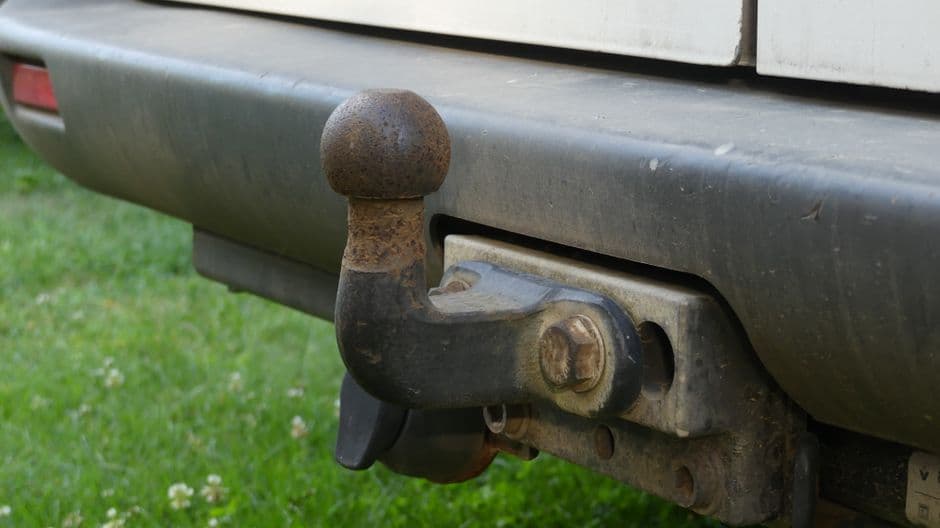
Grease the coupler ball socket and check that safety chains are rated for the trailer's loaded weight, crossed under the tongue so they'd catch the coupler if it ever separated. The National Association of Trailer Manufacturers publishes the towing safety standards most of this checklist is built on.
Frame, deck, and tie-down points
Rust at the frame welds and around the axle mounts is worth catching early, since a trailer frame that fails does so all at once rather than gradually. Wood deck boards rot from underneath first, so check the bottom side, not just where you walk. Tie-down points and D-rings should be re-torqued periodically; a loose tie-down anchor is how a car shifts on a hauler mid-trip.
What to log after every haul
A trailer doesn't come with a dashboard reminding you when the bearings were last packed, which is exactly why it's worth writing down. Log the date, the mileage on the tow vehicle, and what you checked or replaced, the same way you would for the truck pulling it.
Our car maintenance tools guide covers the jack stands and grease gun this work actually needs, and our RV maintenance guide covers the living-quarters side if your trailer has one. Wheelscribe tracks every trailer alongside your other vehicles instead of on a sticky note taped to the tongue, and it's free to start.
Frequently asked questions
How often should trailer wheel bearings be repacked?
Once a year or every 10,000 to 12,000 miles, whichever comes first, and sooner if the trailer regularly gets dunked in water, such as launching a boat. A hot hub, grinding noise, or play when you rock the wheel means it needs attention now.
How do I know if my trailer tires need to be replaced?
Check the tire's age using the four-digit date code on the sidewall, not just the tread depth. Trailer tires deteriorate from UV exposure and age, and most should be replaced around five to six years old even if the tread still looks fine.
What's the difference between surge brakes and electric trailer brakes?
Surge brakes are hydraulic and activate when the trailer pushes forward on the hitch during braking; electric brakes are wired to a controller in the tow vehicle. Surge systems need fluid checks and actuator lubrication, while electric systems need magnet and brake shoe inspection.
How often should I check trailer lights and wiring?
Before every trip. Trailer wiring lives outside and is exposed to road salt and water, so corroded connectors and dead running lights are the most common pre-trip failure on a utility trailer.
What is a breakaway cable on a trailer?
A cable that applies the trailer's brakes automatically if it separates from the tow vehicle. Test the cable and its battery before any long haul, since it's rarely used but critical when it is.
Can I use a passenger car tire on a utility trailer?
No. Trailer tires carry a special ST (special trailer) rating built for a trailer's load and handling characteristics, and they aren't interchangeable with a car tire of the same size.
Start logging your car's history
One car, unlimited entries, free forever. See pricing for what Pro adds.
Create free account